
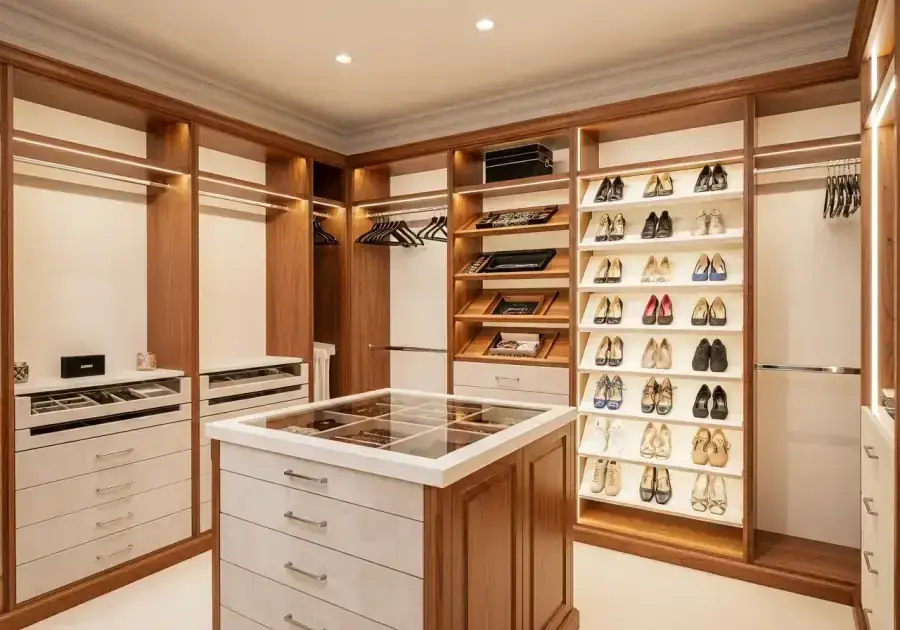
Shoe storage is one of the most discussed — and most often mishandled — elements of any closet design. Shoes end up on the floor, stacked, stuffed in bins, or crammed onto shelves not designed for them. Here is how to do it right.
Know Your Collection
Before choosing a shoe storage solution, count your shoes. Specifically: how many pairs do you own that live in your closet? Be honest. Most people undercount significantly.
For this exercise, count athletic shoes, dress shoes, heels, boots, sandals, and any other footwear that occupies closet space. Now add 20% — that is typically how many more pairs accumulate in the next three years.
If you have fewer than 15 pairs: simple angled shelves or a low shelf system is likely sufficient.
If you have 15–30 pairs: a dedicated angled shelf section with multiple rows is the right solution.
If you have 30+ pairs: you need a shoe wall — a full section of the closet designed exclusively for footwear.
Angled Shoe Shelves
Angled shelves are the most popular shoe storage solution in custom closets. They display each pair at a slight angle (typically 10–15 degrees) with the toe forward, making every pair visible at a glance. They hold shoes efficiently — typically 2 pairs per linear foot of shelf — and make retrieval fast.
Standard angled shelves work well for dress shoes, heels, flats, and sneakers. They are less ideal for tall boots, which need a dedicated boot section or boot storage clips.
Flat Cubbies
Cubbies are individual compartments sized for one or two pairs. They work well if you want each pair in its own space and prefer a more contained, grid-like organization.
The limitation of cubbies is flexibility — the compartment size is fixed. A sneaker cubby may not accommodate a snow boot. For mixed collections, angled shelves are typically more versatile.
Pull-Out Shoe Racks
Pull-out shoe racks mount inside a cabinet section and slide outward for access. They are a clean solution that keeps shoes behind cabinet doors, which some clients prefer for aesthetics. The limitation is that you need to open the cabinet to see the shoes.
The Boot Problem
Tall boots need either a dedicated tall section with flat shelving (folded at the knee), boot clips that hang boots from a standard shelf, or a floor section with enough vertical clearance. If you own multiple pairs of tall boots, plan for them specifically in your closet design — they are the most commonly forgotten item.
What to Avoid
Stacking shoes on open shelves without angling. Pairs become jumbled, mates separate, and retrieval requires unpacking.
Storing all shoes in their boxes. Unless shoes are photographed and labeled, boxes become a mystery. Reserve box storage for rarely worn shoes only.
Floor storage. Shoes on the floor attract dust, make the closet feel chaotic, and require moving shoes to access others. It is always a temporary solution that becomes permanent.
See the Options In Person
The best way to understand shoe storage is to see it. Visit our showroom at 1741 State Street in Bettendorf to see angled shelves, cubbies, and other shoe storage configurations in working displays. Call (563) 355-8295.