A cluttered pantry costs money in ways that aren't obvious until you add them up. Food gets lost in the back of shelves and expires. You buy duplicates of things you already have because you couldn't see them. Meal prep takes longer because nothing is where it should be. A well-designed pantry — one organized around how your family actually shops and cooks — solves all of these problems at once.
Think in Zones Before You Think in Storage Products
The most important pantry idea isn't a product — it's a principle. Zone your pantry by how you use it, not by the shape of the containers. Every family has different zones based on their habits, but common categories include everyday snacks, baking supplies, canned goods, dry goods, breakfast items, and small appliances.
When categories have dedicated zones, everyone in the family knows where things go and where to find them. Groceries get put away in the right place. Kids can grab their own snacks without disrupting other areas. Meal prep becomes faster because the ingredients for any given recipe are clustered together.
Before you buy a single container or shelf, write down the six to eight categories that describe how your family uses a pantry. Then design the space around those zones.
Pull-Out Shelves Change Everything
Standard fixed shelves create a problem: anything stored behind something else disappears. Cans stack up, items get pushed to the back, and half your pantry becomes effectively invisible.
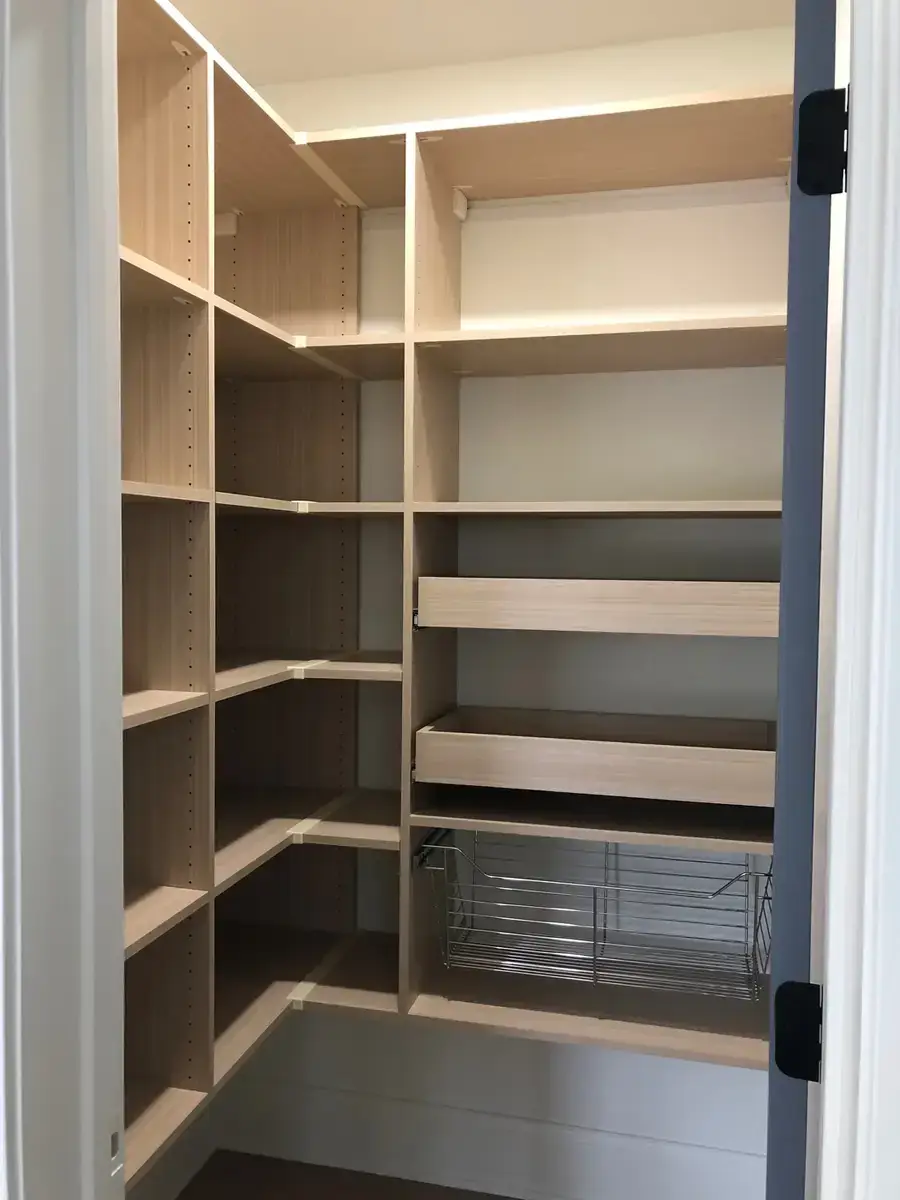
Pull-out shelves — drawer-style shelves that slide forward on full-extension glides — solve this completely. Everything stored on a pull-out is accessible. You can see to the back of the shelf without reaching or rearranging. When you slide the shelf out, the full depth of the pantry opens up.
Pull-outs are especially valuable for canned goods, oils, and spices, where depth creates clutter. A single pull-out shelf can reveal items you forgot you owned and help you use everything before it expires.
Use Every Inch of Vertical Space
Most pantries waste significant vertical space because shelves are positioned for cans, not for the tallest items in the pantry. Map out your tallest items — cereal boxes, oil bottles, larger containers — and make sure at least one zone has the vertical clearance they need.
Then use the space between shorter items. If canned goods only need seven inches of clearance and you have twelve, that's five inches of vertical space going to waste on every shelf. Adjustable shelving lets you fine-tune every shelf height to match what actually lives on it.
For tall pantries, an upper zone for overflow and rarely-used items, accessed with a step stool, adds a significant amount of storage without consuming floor space or prime eye-level real estate.
Door Storage: Overlooked and Underused
The inside of a pantry door is an asset most homeowners ignore. Door-mounted storage — spice racks, bins, foil and wrap holders, or shallow shelving — adds accessible storage without taking any interior shelf space.
Door storage works especially well for frequently grabbed items: spices you use every day, sandwich bags, aluminum foil, and similar small goods. Keeping them on the door means they're visible immediately when you open the pantry, without requiring you to step inside.
This is one of the easiest and least expensive pantry upgrades available, and it's often built directly into a custom pantry system.
Labeled Containers and Bins
Clear containers make the contents of your pantry visible at a glance. Bulk dry goods — pasta, rice, beans, grains, cereal — stay fresher longer in airtight containers than in their original packaging, and uniform containers stack more efficiently and make shelves look organized even when they're full.
Labels don't have to be fancy to be functional. Consistent labels that identify the contents and, where relevant, the expiration date make restocking and inventory easy. Family members who can read labels are far more likely to put things back in the right place.
Working With the Pantry You Have
Not everyone has a purpose-built walk-in pantry. Many Quad Cities homeowners have a reach-in pantry, a converted hall closet, or a section of cabinetry near the kitchen. Custom pantry design works with any configuration.
If you have an underused closet near your kitchen — a coat closet, a linen closet, or a utility space — it may already be your next pantry. We convert closets into custom pantry systems regularly, and the result is often a far better pantry than many built-in kitchen pantry cabinets.
Take the Next Step
If your pantry frustrates you, it doesn't have to. Our designers work with whatever space you have — large or small — and create systems that match how your family actually lives.
Schedule a free consultation to see what's possible for your kitchen storage. You can also visit our showroom to see pantry displays in person. We've been building custom pantries for Quad Cities families since 1989, and we'd love to show you what yours could become. For a broader look at your home organization options, browse our storage services.