
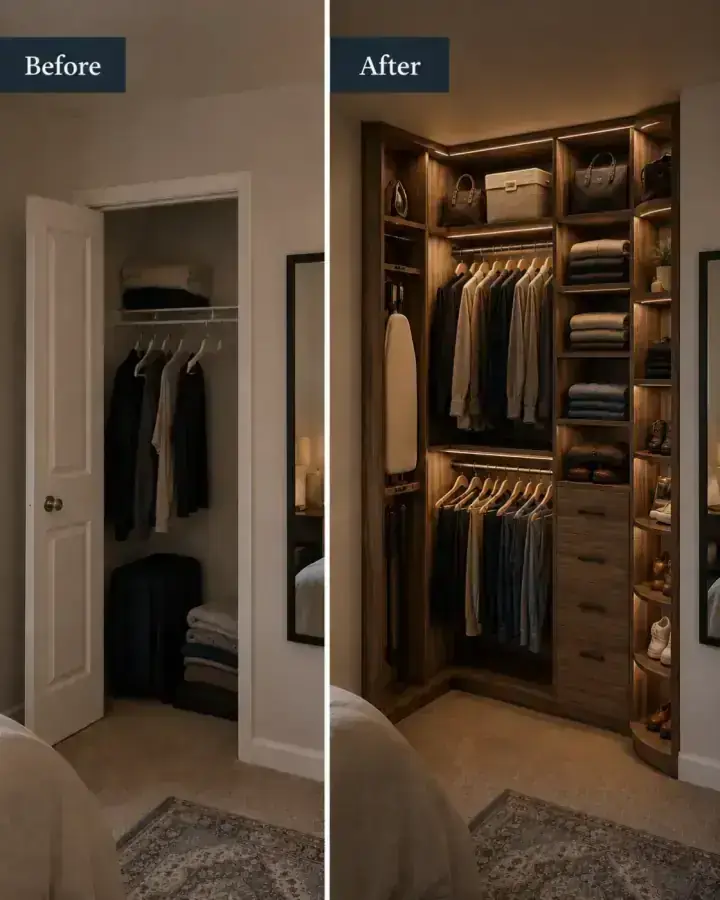
The DIY closet kit market has grown significantly. You can buy systems at IKEA, The Container Store, Home Depot, or Lowes. Some are genuinely good products. But there are real differences between a DIY kit and a custom-designed, professionally installed system — and they matter for some buyers more than others.
Here is an honest comparison.
Fit
DIY kits use standard-size components that approximate your space. A standard 36-inch section gets adjusted to fit a 38-inch gap. The result works but does not quite fit. Gaps at the ends, unused vertical space, sections that don't align perfectly.
Custom systems are precision-measured and built to your exact dimensions. Every component is cut to fit the specific space — no gaps, no approximations, no adjustment compromises.
Drawer Options
DIY kits offer limited drawer options — often only a few standard sizes, and at relatively high cost per unit compared to the rest of the system.
Custom systems offer full-extension drawer towers in multiple widths, heights, and depths, with soft-close hardware as a standard feature. Drawers are the highest-value functional element of a closet system — and they are where custom systems most significantly outperform kit systems.
Installation
DIY kits require self-installation. For a motivated, experienced DIYer, this is manageable — typically 4 to 8 hours for a standard reach-in closet. Errors in measurement or installation are the buyer's responsibility.
Custom systems are professionally installed by an experienced team. Installation is included in the project cost. Errors, if any, are corrected by the company.
Durability
DIY kits use thinner panels (typically 5/8-inch melamine) and lighter-duty shelf pins and hardware. Under heavy loads, shelves can bow. Over time, components wear faster than professionally installed systems.
Custom systems use thicker panels (typically 3/4-inch TFL), heavy-duty shelf pins, and hardware selected for 20+ year durability. Professional systems installed correctly stay solid for decades.
Cost Comparison (Honest)
A basic DIY reach-in kit for a 6-foot closet might cost $300–$500 in materials plus your time. A custom system for the same closet costs $800–$1,500 installed.
A large walk-in in DIY components might cost $1,500–$2,500 in materials plus significant installation time. The equivalent custom system might cost $4,000–$6,000 installed.
The gap is real. For some buyers at some budgets, a well-executed DIY kit is the right answer. For most buyers who have lived with a DIY kit for a few years and are now comparing it to custom, the custom system wins on fit, drawers, and durability.
Who Should DIY
A DIY kit makes sense if: you are a skilled DIYer, your budget is genuinely constrained, your space is a standard size without awkward dimensions, and you do not need drawer storage.
Who Should Go Custom
A custom system makes sense if: you want it to fit perfectly, you need drawers, you have an awkward space (sloped ceiling, irregular dimensions, outlets), you want professional installation, or you plan to own the home long-term and want the system to last.
To see custom and discuss what is right for your situation, call (563) 355-8295 or visit our Bettendorf showroom.