
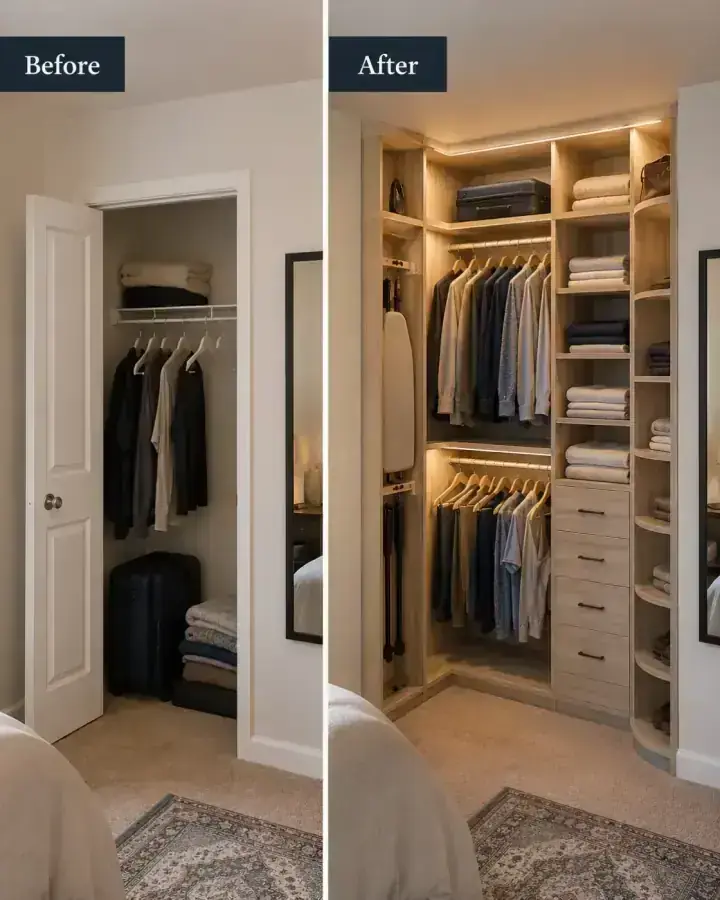
Walk into any closet showroom and you'll see dozens of accessories presented as must-haves. Some of them are. Some of them are expensive features that sound appealing in the showroom and rarely get used after the first week. Knowing the difference before you design your closet saves money and avoids the frustration of a beautiful system with components that don't serve your actual habits.
This guide is honest about each category — what the accessory does, who benefits from it, and whether it's worth the investment for most households.
Soft-Close Drawers
Worth it for almost everyone.
Soft-close drawer mechanisms slow the drawer as it nears closed, preventing the drawer from slamming. The benefit is functional as much as it is acoustic — drawers that don't slam last longer, stay quieter in early-morning routines, and feel more premium in daily use.
Soft-close mechanisms are available on virtually all quality custom closet drawer systems. The cost differential over standard drawers is modest. If you're investing in a built-in drawer tower, soft-close is a standard expectation, not a luxury upgrade.
Valet Rods
Worth it if your morning routine involves laying out clothes the night before, or if you frequently travel.
A valet rod is a pull-out horizontal bar — typically installed inside a cabinet or on a drawer face — that provides a temporary hang space for freshly pressed items, outfits you're planning to wear, or clothes recently returned from the cleaner.
For someone who lays out tomorrow's outfit the night before, a valet rod provides a dedicated spot that isn't the back of a chair or the edge of a door. For frequent travelers, it's useful for packing.
For households where no one plans outfits in advance and dry cleaning rarely comes through the door, a valet rod will go unused. Be honest about your habits before including one.
Pull-Out Hampers
Worth it for most households, especially families.
A pull-out hamper is a canvas or fabric bin mounted in a drawer frame that slides into a cabinet. Dirty clothes go in the bin; the bin slides closed behind the cabinet face. The laundry disappears completely.
This is one of the more universally useful accessories in a custom closet. A closet with a built-in hamper generates less visual clutter, keeps dirty clothes contained, and eliminates the freestanding hamper that always seems to end up in the wrong place.
For families with multiple children, a hamper tower with two or three pull-out bins per closet helps each child sort before laundry day. The habit becomes easier to maintain when the infrastructure supports it.
Jewelry Trays and Drawer Inserts
Worth it for serious jewelry collections; optional for everyone else.
A dedicated jewelry drawer — a shallow drawer lined with felt or velvet, divided into compartments — keeps necklaces untangled, rings visible, and earrings paired. For anyone with a meaningful jewelry collection, it is genuinely transformative: no more searching through a box, no more knots, no more lost pieces.
For households with minimal jewelry — a few everyday pieces and nothing particularly valuable — a jewelry tray is a pleasant upgrade but not a priority. The decision is easy: if you currently have a jewelry box or dish where things get tangled and lost, a dedicated drawer insert will change that. If you own five pieces and keep them on a tray without problems, it's optional.
Belt and Tie Racks
Worth it if you wear belts or ties regularly; skip it if you don't.
Pull-out belt and tie racks mount inside a drawer or cabinet and provide individual hooks for each belt or tie, keeping them organized, wrinkle-free, and easy to scan. The key word is "pull-out" — a fixed rack inside a dark cabinet adds no organization value. Pull-out hardware brings the rack forward so you can see and access everything.
If belts are a daily part of your wardrobe, or if you own a dozen ties that currently live in a pile, a pull-out rack is a genuine quality-of-life improvement. If you own two belts and three ties, a standard hook works just as well.
Shoe Shelving Options
Worth it in some form for virtually everyone — but the right type depends on your collection.
There's more variation in shoe storage options than in any other accessory category. Fixed angled shelving is the most cost-effective option and works well for standard footwear. Flat shelving with adjustable heights accommodates boots, wedges, and heels that don't fit on angled racks. Pull-out shoe drawers with clear fronts provide a neat, dust-protected option. Cubbies work well for athletic shoes and casual footwear.
The right choice depends on what you own. If you have a significant collection of dress shoes, heeled shoes, or boots, investing in the right storage type pays for itself in protected footwear and faster morning routines. If you primarily wear athletic shoes and a couple of dress pairs, simple angled shelving works fine.
Accessories That Are Often Oversold
A few accessories frequently appear in showrooms but deliver less real-world value than they suggest: motorized rotating tie racks (theatrical but slower to use than pull-outs), decorative jewelry armoires as closet add-ons (beautiful but duplicative of built-in trays), and built-in ironing boards inside closet cabinets (used rarely, since most people iron near an outlet and a mirror, not inside a closet).
These aren't bad products — they're just not the right investment for most households. Focus on accessories that serve your actual daily habits, not the aspirational routine you imagine having.
Starting the Conversation
The best way to figure out which accessories belong in your closet is to talk through your real morning routine with a designer. We'll help you distinguish between what you'll use every day and what sounds better in theory than in practice.
Schedule a free consultation to start that conversation. You can also explore our full range of storage solutions to see how we approach every room in your home.