
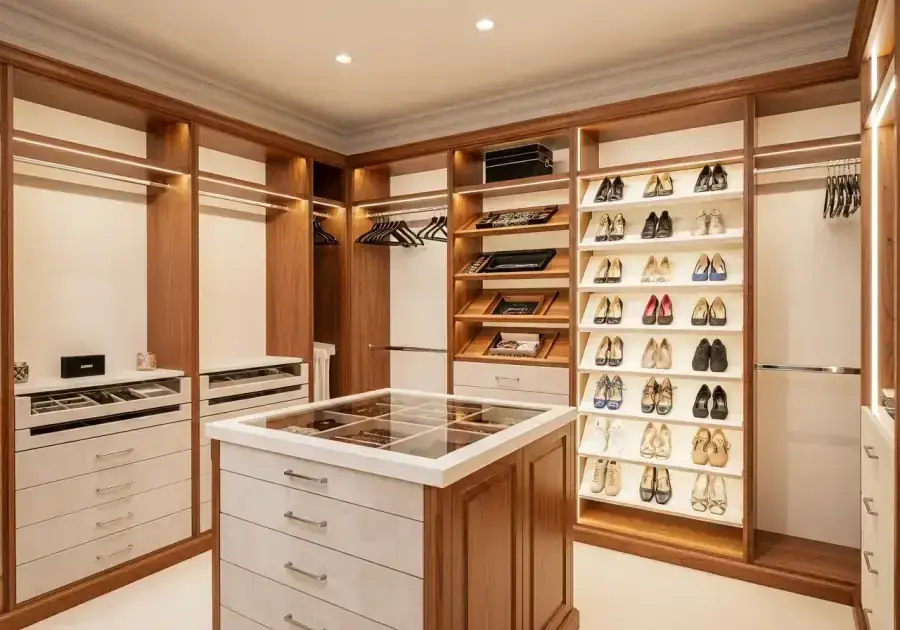
The cloffice — a closet converted into a home office — is one of the most efficient uses of underutilized space in any home. If you have a spare closet near a quiet area of the house, you may already have your home office. You just have not built it yet.
Why Closets Make Great Offices
A closet office has several natural advantages over a corner desk in a bedroom or living room:
Containment. When you close the doors, the office disappears. Work-life balance becomes architecturally enforced.
Focus. The walls on three sides create a natural focus environment. There is no peripheral visual noise — just the work in front of you.
Efficiency. Because the space is small, every element must earn its position. A well-designed cloffice has no wasted real estate.
Privacy for video calls. A contained space means cleaner backgrounds, less ambient noise, and a more professional appearance on calls.
What Goes Into a Cloffice Design
The desk surface. This is the foundation. A built-in desk at the correct height — typically 28 to 30 inches for sitting, 42 to 44 for standing — with enough surface area for your monitor, keyboard, and working documents.
Monitor placement. A monitor at eye level reduces neck strain. Built-in monitor shelves or mounting blocks are part of any good cloffice design.
Shelving. Above the desk, floor-to-ceiling shelving holds books, binders, reference materials, and display items. This is what gives the cloffice vertical storage that a furniture desk cannot provide.
File storage. A drawer section with legal or letter-size file drawers keeps documents organized and accessible without visible clutter.
Cable management. Built-in cable routing channels keep cords organized and out of sight. This is where many DIY cloffices fail — cords become tangled and visible.
The Door Question
Cloffices work best in closets with either French doors that open outward, sliding doors that disappear to the sides, or no doors at all if the alcove is in a private enough area of the home.
Bifold doors are the most common original installation and the least useful for a cloffice — they block part of the opening and make the working area feel cramped. Replacing bifolds with sliding or French doors is a relatively small investment that dramatically improves the cloffice experience.
Lighting Is Critical
A closet that was designed for clothes storage has overhead lighting at best. A functional home office needs task lighting at the work surface level — under-shelf LEDs or a desk lamp mounted at eye level. Poor lighting in a home office causes eye strain and reduces productivity.
What Size Closet Works?
A cloffice works best in a closet at least 5 feet wide and 24 inches deep. Most standard bedroom and hall closets meet these minimum dimensions. Larger closets allow for L-shaped or U-shaped desk configurations.
Reach-in closets with double-door openings are ideal candidates — typically 6 to 8 feet wide and accessible from the front.
To design your cloffice, call (563) 355-8295 or visit our showroom at 1741 State Street in Bettendorf.