
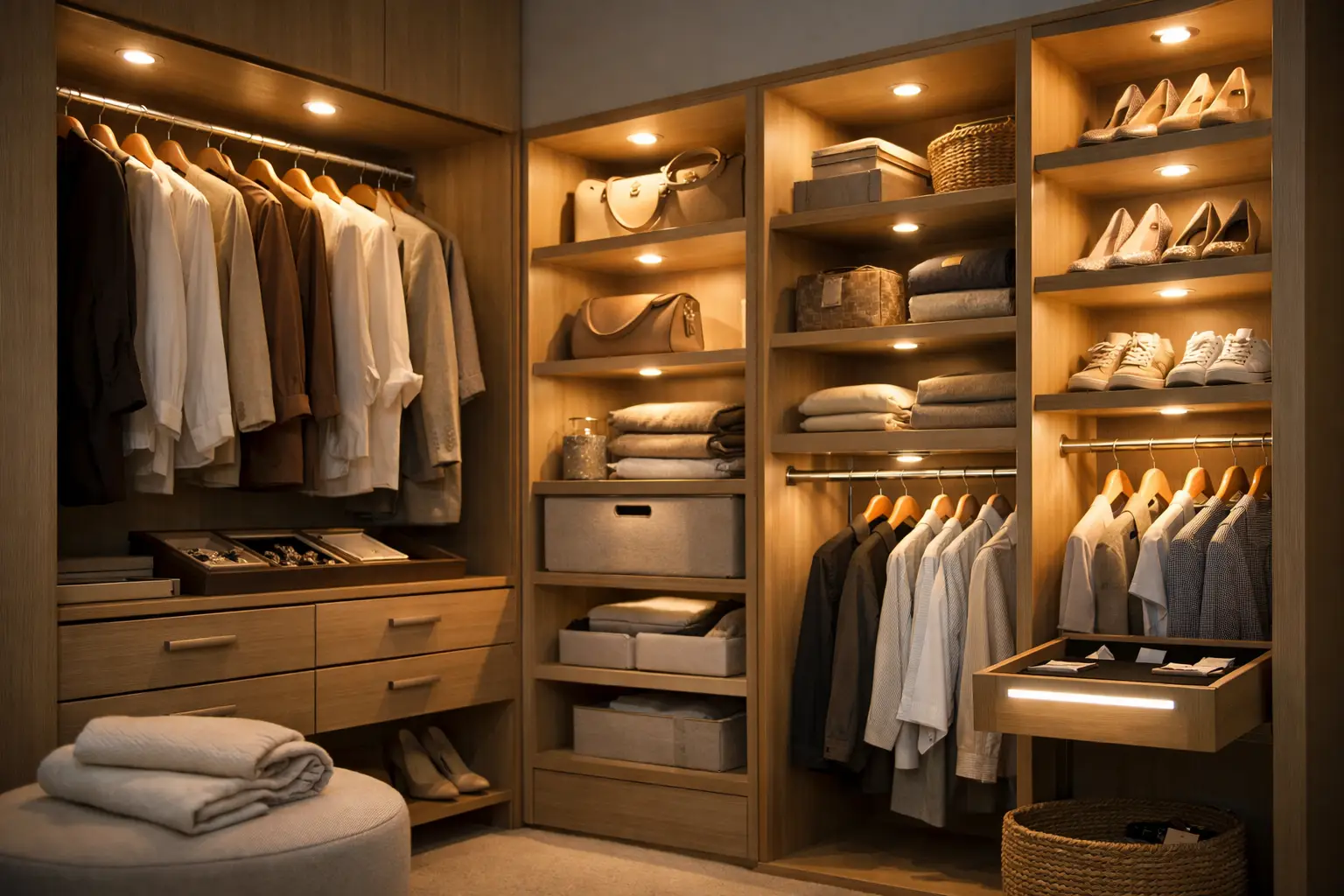
A closet can look well organized on paper and still feel frustrating to use if the lighting is poor. That is why a good closet lighting ideas guide starts with function, not just style. When you can clearly see shelves, drawers, hanging clothes, and shoes, the whole space works better every day.
For many homeowners, closet lighting gets treated as an afterthought. A single ceiling bulb may technically light the room, but it often leaves dark corners, shadows under shelves, and a dim view of what you actually own. Better lighting fixes that. It makes morning routines easier, helps you keep the space organized, and gives a custom closet a finished, more comfortable feel.
Closet lighting ideas guide: start with how you use the space
The best closet lighting plan depends on the size of the closet, the layout, and how you move through it. A walk-in closet usually needs layers of light so the center of the room, shelving walls, and drawers all stay visible. A reach-in closet often needs a simpler approach, but fixture placement matters even more because every inch counts.
Think first about the areas where shadows naturally show up. Upper shelves, corners, cabinet interiors, and spaces below hanging rods are common trouble spots. If your current light source is directly overhead, it may brighten the floor but still leave clothes and accessories harder to see. Good lighting should help you identify colors, textures, and items quickly without feeling harsh.
It also helps to think about time of day. Many closets get used early in the morning or late at night, when natural light is limited or nonexistent. In those cases, lighting should be bright enough to be useful but soft enough that it does not feel glaring the moment you switch it on.
The three lighting layers that work best in closets
Most well-designed closets use a combination of ambient, task, and accent lighting. You do not always need all three, but understanding the difference makes planning easier.
Ambient lighting is the main source of general illumination. This is often a flush-mount ceiling fixture, a recessed light, or a compact LED fixture that lights the overall space. In smaller closets, this may be enough on its own if the layout is simple.
Task lighting is what helps you actually use the closet. This could be LED strip lighting under shelves, lights inside drawers, or vertical lighting near mirrors or dressing areas. If you have ever struggled to tell navy from black in a dim closet, you have felt the need for better task lighting.
Accent lighting is the finishing layer. It is not strictly required, but it can highlight display shelves, glass-front cabinets, or specialty storage areas. In a larger walk-in, it can make the space feel more polished without sacrificing function.
Best fixture options for different closet layouts
The right fixture depends on ceiling height, storage design, and how custom the space is.
Flush-mount ceiling lights
Flush-mount fixtures are one of the most practical options for standard closets. They provide broad light, stay close to the ceiling, and work well where headroom is limited. For reach-in closets and smaller walk-ins, this is often the safest and cleanest choice.
Choose a fixture with a diffuser that softens the light and reduces glare. If the bulb is exposed, the light can feel too sharp in a small enclosed space.
Recessed lighting
Recessed lights give closets a clean, built-in look. They work especially well in walk-ins with enough ceiling space and a balanced layout. A few recessed lights placed strategically can spread light evenly across the room.
The trade-off is that placement matters a lot. If lights are centered without considering shelving depth and hanging sections, you may still end up with shadows. In many cases, recessed lights work best when combined with shelf or cabinet lighting.
LED strip lighting
LED strip lighting is one of the most useful upgrades for modern closets. It can be installed under shelves, along vertical panels, inside cabinets, or around drawer sections. This brings light closer to where items are stored rather than relying only on overhead lighting.
It is especially effective in custom closet systems because the strips can be integrated into the design. The result feels intentional, not added on later.
Puck lights
Puck lights are small round fixtures often used to spotlight shelves, cubbies, or display areas. They can be a good fit for shoe storage, handbags, or decorative shelving. In a basic closet, they may be more feature than necessity. In a larger or more customized space, they can add helpful focused light.
Motion-sensor lighting
Motion-sensor lights are practical for closets because they turn on when you enter and off when you leave. That is convenient when your hands are full, and it can help reduce wasted energy. Battery-operated versions are common for smaller projects, while hardwired options offer a more permanent solution.
For homeowners who want simple convenience, this is one of the easiest upgrades to appreciate right away.
Brightness, color temperature, and comfort
Not all closet lighting should look the same. A bright white commercial-style light may make the closet visible, but it can also feel cold and uncomfortable in a home.
For most closets, LED lighting is the best choice because it is energy efficient, long lasting, and available in a range of color temperatures. A soft white to neutral white range often feels best. It keeps colors accurate enough for clothing choices while still feeling warm and comfortable.
If the light is too warm, it may make it harder to distinguish certain clothing colors. If it is too cool, the space can feel sterile. That middle ground usually works best in family homes.
Brightness should match the closet size. A small reach-in does not need the same output as a large dressing room. Too much light in a compact closet can feel harsh, while too little light in a walk-in defeats the purpose of the space. This is one reason custom planning matters. Lighting should fit the room, not just the fixture box.
Safety matters more than style
Closet lighting should always be chosen with safety in mind. Fixtures generate heat differently, and closets naturally place lighting close to clothing, fabric, and stored items. That is why LED fixtures are often preferred. They run cooler than many traditional bulbs and are better suited for enclosed areas.
Placement is also important. Lights should not be installed where hanging clothes can crowd them or where storage could block ventilation around the fixture. Building code requirements can vary depending on fixture type and distance from storage areas, so professional guidance is worth having if you are planning a full upgrade.
This is especially true in older homes, where wiring may not support the kind of lighting layout you want without updates.
Where to place closet lighting for the best results
Even the best fixture can underperform if it is placed poorly. In walk-in closets, overhead lights should generally line up with walking paths and open floor areas rather than being hidden behind you when you stand at a shelf. Shelf lighting should be positioned to wash light downward or forward, not straight into your eyes.
Vertical lighting can be helpful near mirrors, wardrobe towers, and dressing areas. It reduces shadows on clothing and gives a clearer view than a single overhead source.
In reach-in closets, a centered ceiling fixture can work, but side-mounted or shelf-mounted lighting may improve visibility if deep shelves or hanging rods create heavy shadows. It depends on the depth and organization of the closet.
When a simple upgrade is enough and when a full lighting plan makes sense
Not every closet needs a full redesign. If your storage layout already works well, replacing an outdated fixture with a brighter, better-placed LED option may solve the problem. Adding motion-sensor strip lighting inside a dark section can also make a noticeable difference without major construction.
On the other hand, if you are already redesigning the closet, lighting should be part of the plan from the beginning. Integrated lighting looks better, performs better, and avoids the patchwork feel that can happen when fixtures are added after shelving is installed.
That is often where a custom storage company can bring the most value. Instead of treating lighting as a separate decision, the layout, shelving, drawers, and illumination can all work together. For homeowners in the Quad Cities, Comfort Concepts QCA takes that practical approach - building storage spaces that are easier to use, easier to maintain, and more comfortable day to day.
A well-lit closet does more than make the space look nicer. It helps the whole room function the way it should, with less guesswork and less daily frustration. If you are planning updates, choose lighting that supports how you actually live, and the closet will feel better every time you open the door.