
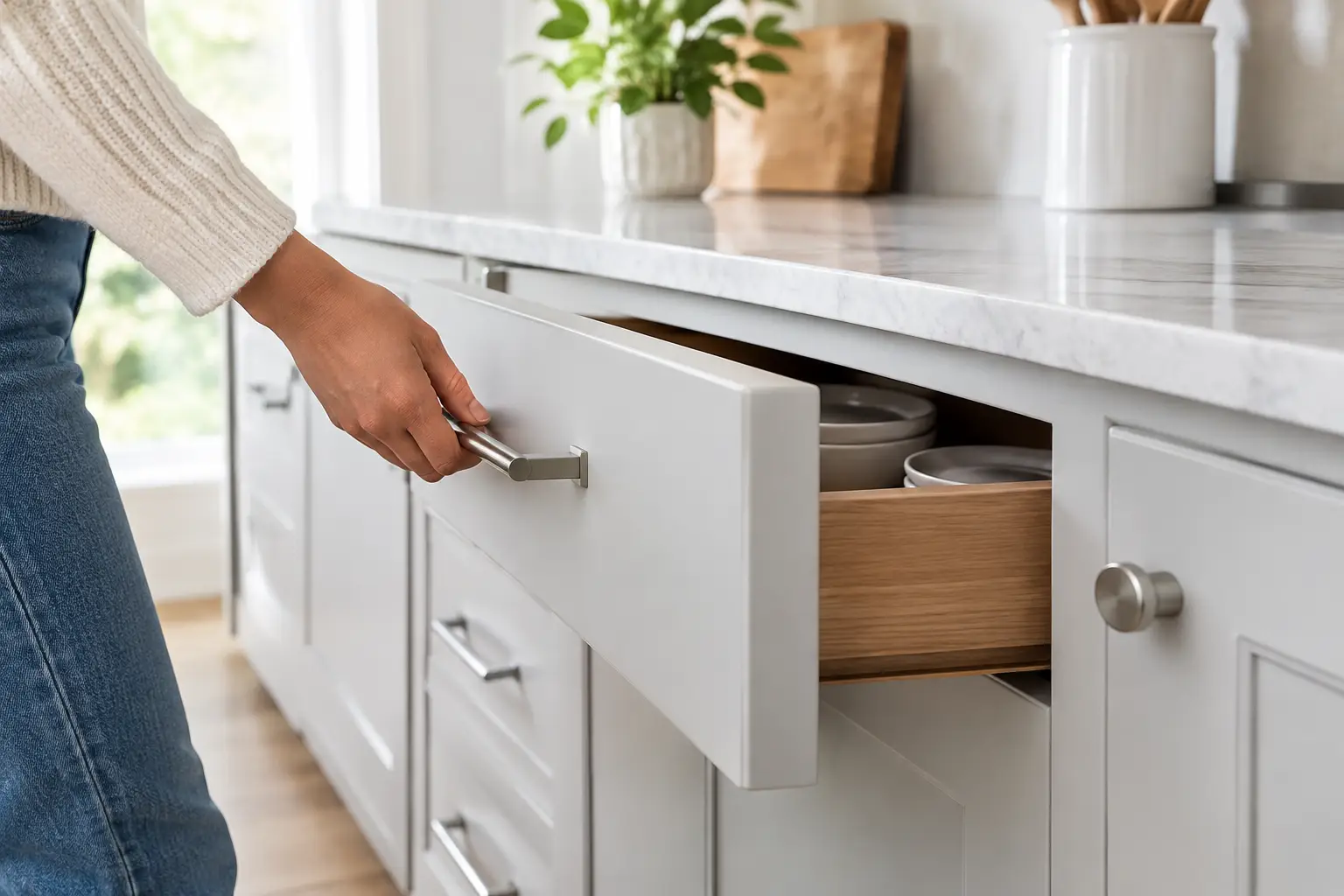
A cabinet can look beautiful on installation day and still become frustrating within a few months if the doors slam, drawers stick, or handles feel loose in your hand. Cabinet hardware is what turns built-in storage from a nice-looking feature into something dependable enough for daily life. In kitchens, closets, laundry rooms, mudrooms, and home offices, those small working parts carry a surprising amount of responsibility.
For Quad Cities homeowners, the right choices are rarely about following a passing trend. They are about making morning routines easier, keeping family spaces organized, and investing in storage that continues to work well as the household changes.
What Counts as Cabinet Hardware?
Cabinet hardware includes the visible pieces you touch and the working components hidden inside the cabinetry. Knobs and pulls help you open doors and drawers. Hinges control door movement and alignment. Drawer slides support the drawer box and determine how smoothly it opens, closes, and carries weight.
There are also specialty pieces, such as pull-out pantry hardware, rotating corner cabinet systems, valet rods, tie racks, tilt-out trays, and waste-bin pullouts. These features are especially useful in custom storage because they bring items forward instead of leaving them buried behind shelves or in hard-to-reach corners.
Not every space needs every accessory. A busy family mudroom may benefit most from sturdy hooks, easy-grip pulls, and drawers that hold shoes or pet supplies. A primary closet may benefit more from soft-close drawers, jewelry organizers, and hardware that keeps accessories visible. Good design begins with how the room is actually used.
Start With Daily Use, Not the Finish
It is easy to choose hardware based on color alone. Matte black, brushed nickel, brass, bronze, and chrome all have their place, but appearance should come after function. Think about which cabinets get opened repeatedly, who uses them, and what they need to hold.
A deep drawer in a pantry or laundry room may be loaded with cans, cleaning supplies, or bulky linens. It needs slides rated for that weight. A narrow drawer holding office supplies has much lighter demands. A tall cabinet door may need additional hinges or stronger hinge support so it stays aligned over time.
Handle shape matters, too. Small round knobs can look clean and classic, but they may be less comfortable for someone opening drawers with full hands. Longer pulls give more room to grip and can make wide drawers easier to open. In homes with young children, older relatives, or anyone with limited hand strength, an easy-to-grasp pull can make everyday storage noticeably more comfortable.
Hinges: Small Parts With a Big Job
Cabinet hinges are mostly out of sight, which is why they are often overlooked. Yet they affect how doors sit, how far they open, and whether they close quietly. Quality adjustable hinges allow an installer to fine-tune the door position so the gaps between doors remain even and the cabinet has a finished appearance.
Soft-close hinges are a popular option for good reason. They slow the door just before it closes, preventing slamming and reducing noise in busy rooms. They are particularly helpful in early mornings, late nights, and shared household spaces. They can also reduce wear on cabinet doors over time.
Soft-close hardware is not automatically necessary everywhere. In a basic utility cabinet that is rarely opened, standard hinges may be perfectly practical. But on frequently used closet drawers, kitchen-style cabinets, or a family command center, the quieter and more controlled movement is often worth the investment.
Drawer Slides Should Match the Load
Drawer slides are one of the clearest differences between storage that feels solid and storage that feels temporary. Basic side-mount slides can be suitable for lighter drawers, but full-extension slides are often more useful in custom cabinetry. They allow the drawer to come out far enough for you to see and reach items at the back.
For many homeowners, full extension solves a familiar problem: buying storage space but still losing things in the last few inches of a drawer. In a closet, that may mean socks, belts, or seasonal accessories. In a pantry, it may mean spices, snacks, or baking supplies. Better access helps the space stay organized because items are easier to put away properly.
Soft-close drawer slides provide the same controlled close many people appreciate in door hinges. Heavy-duty slides are a smart choice for wide drawers, pull-out hampers, filing drawers, and storage intended for dense or bulky items. The right slide is not the most expensive option in every case. It is the option designed for the drawer’s size, contents, and expected use.
Choosing Knobs and Pulls That Feel Right
Visible cabinet hardware helps set the character of a room, but it should also feel natural in your hand. Before committing to a style, consider the scale of the cabinet face. Large doors and broad drawers usually look and function better with longer pulls. Smaller drawers can accommodate shorter pulls or knobs without looking crowded.
Consistency helps create a calm, finished look. That does not mean every handle in the house must match exactly. A mudroom, pantry, and home office can have different needs and still feel connected when the finishes coordinate. For example, brushed nickel may work well across several rooms, while the pull length changes to suit each cabinet.
Finish selection also depends on maintenance and the room’s overall design. Brushed finishes are often forgiving with fingerprints and everyday use. Polished finishes offer a brighter look but can show smudges more easily. Dark finishes create contrast against light cabinetry, while warmer brass or bronze tones can add softness to woodgrain finishes and neutral colors.
Trends can be helpful for inspiration, but the best choice is one you will be happy to see and use every day. Hardware is easier to update than cabinetry, yet selecting a durable, comfortable style from the start avoids an unnecessary project later.
Specialty Cabinet Hardware Improves Access
The most useful storage is not always the storage with the most shelves. It is the storage that makes items easy to reach, easy to see, and easy to return. Specialty cabinet hardware can make a major difference in tight or high-use areas.
Pull-out shelves are helpful in lower cabinets and pantry spaces where bending and reaching become frustrating. A pull-out hamper can keep laundry contained without taking up floor space. Pull-down hanging rods make use of vertical closet space while keeping clothing accessible. Pull-out baskets can simplify snack storage, linens, cleaning products, or sports gear.
Corner areas deserve special attention because they are often underused. Depending on the cabinet layout, a rotating tray, pull-out system, or carefully designed open shelf may provide better access than a deep, dark corner. There is no single right solution. The best choice depends on what needs to be stored and how often it is needed.
Why Professional Installation Matters
Even high-quality hardware can disappoint if it is installed poorly. Doors need accurate alignment. Drawer slides need to be level and securely mounted. Pulls and knobs need to be placed consistently so the finished cabinetry looks intentional and functions comfortably.
Professional installation also helps avoid common issues such as doors rubbing together, drawers that drift open, uneven gaps, or handles that loosen after regular use. In a custom storage project, hardware should be selected as part of the overall design rather than added as an afterthought. That approach makes sure drawer boxes, cabinet dimensions, clearances, and accessories all work together.
Comfort Concepts QCA plans cabinetry and organizational features around the way each household lives. That means considering more than finishes and shelf counts. It means discussing what you store, what gets used every day, where clutter collects, and which details will make the room easier to maintain.
A Practical Way to Make Your Selections
When reviewing options, start by identifying the rooms that cause the most daily frustration. A closet with hard-to-reach drawers, a laundry room without a place for hampers, or a pantry where food disappears behind fixed shelves may benefit from better hardware more than from simply adding another cabinet.
Then decide where premium features will have the greatest payoff. Many homeowners choose soft-close hinges and full-extension drawer slides throughout the project, then add specialty pullouts in the areas where access is most difficult. This can balance convenience, durability, and budget without cutting corners on the pieces used every day.
Cabinet hardware may be one of the smallest parts of a storage project, but it is the part you feel every time you open a drawer, reach for a towel, put away groceries, or get ready for work. Choose it with the same care you give the cabinetry itself, and your organized space will feel more comfortable long after installation day.